



Copy stand for analog digitization and scanning
Copy stand for analog digitization and scanning
Availability for pickups could not be loaded
Free shipping in Germany
Free shipping in Germany
With free shipping to your home in 2-4 days.
30-day money-back guarantee
30-day money-back guarantee
You can test any product for 30 days. If you are not satisfied, we will refund the full purchase price including shipping costs. No ifs, ands, or buts.
Your legal guarantee rights
Your legal guarantee rights

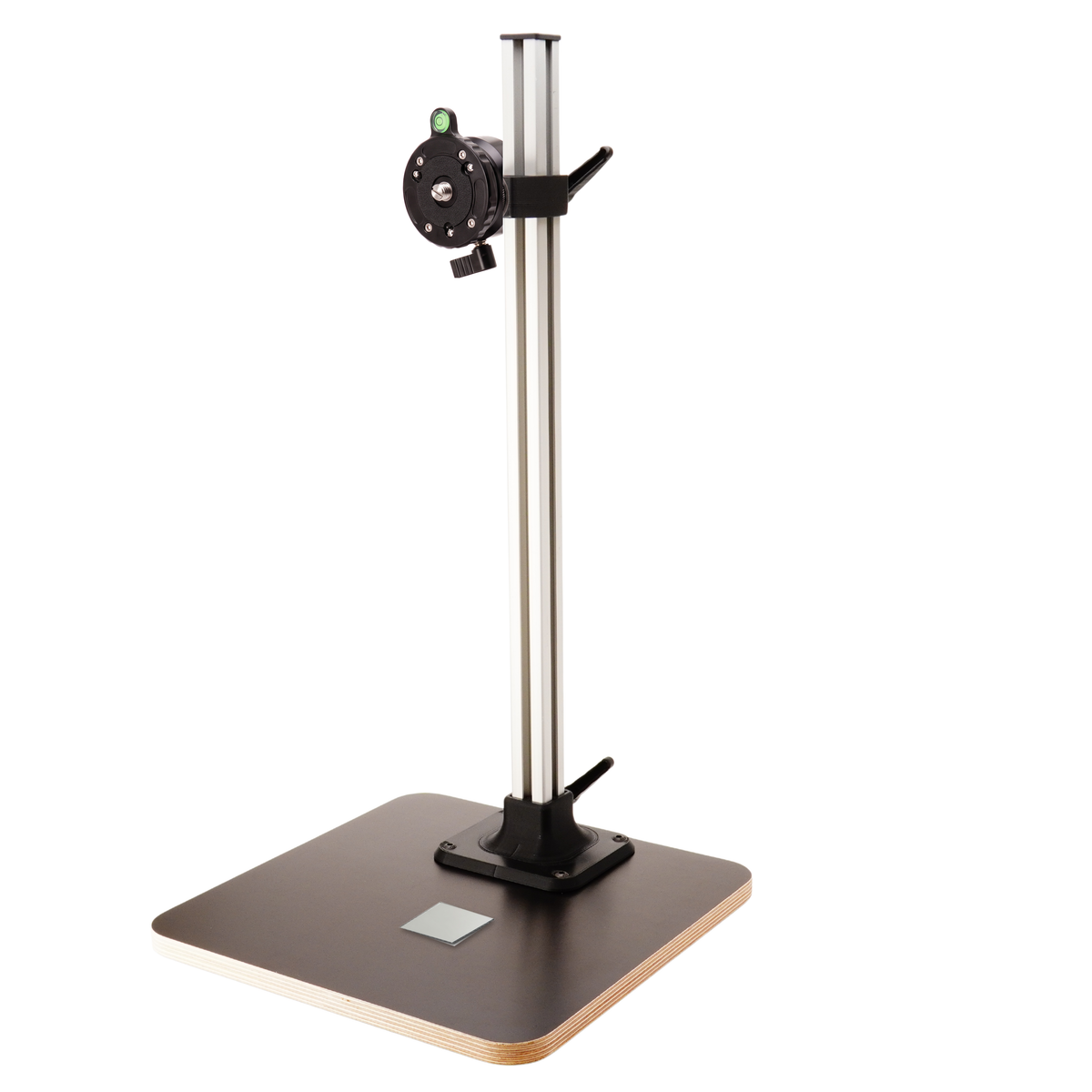
- Tip-resistant construction: The profile is flush-mounted in the 20 mm film-faced plywood: CNC-milled, with four threaded inserts, not screwed on top. It remains stable with up to ~1.5 kg on the arm; from around 1.9 kg total load, the profile bends slightly. It is not designed for heavy-duty setups with a bellows unit, macro rail, and heavy ball head.
- Designed for use with a tripod head: The camera mount has a 3/8" thread (professional standard, more load-bearing than 1/4-20), compatible with all common ball heads and adapter plates. If you do not have your own head, choose the “Copy Stand + Leveling Base” variant, optionally with an alignment mirror.
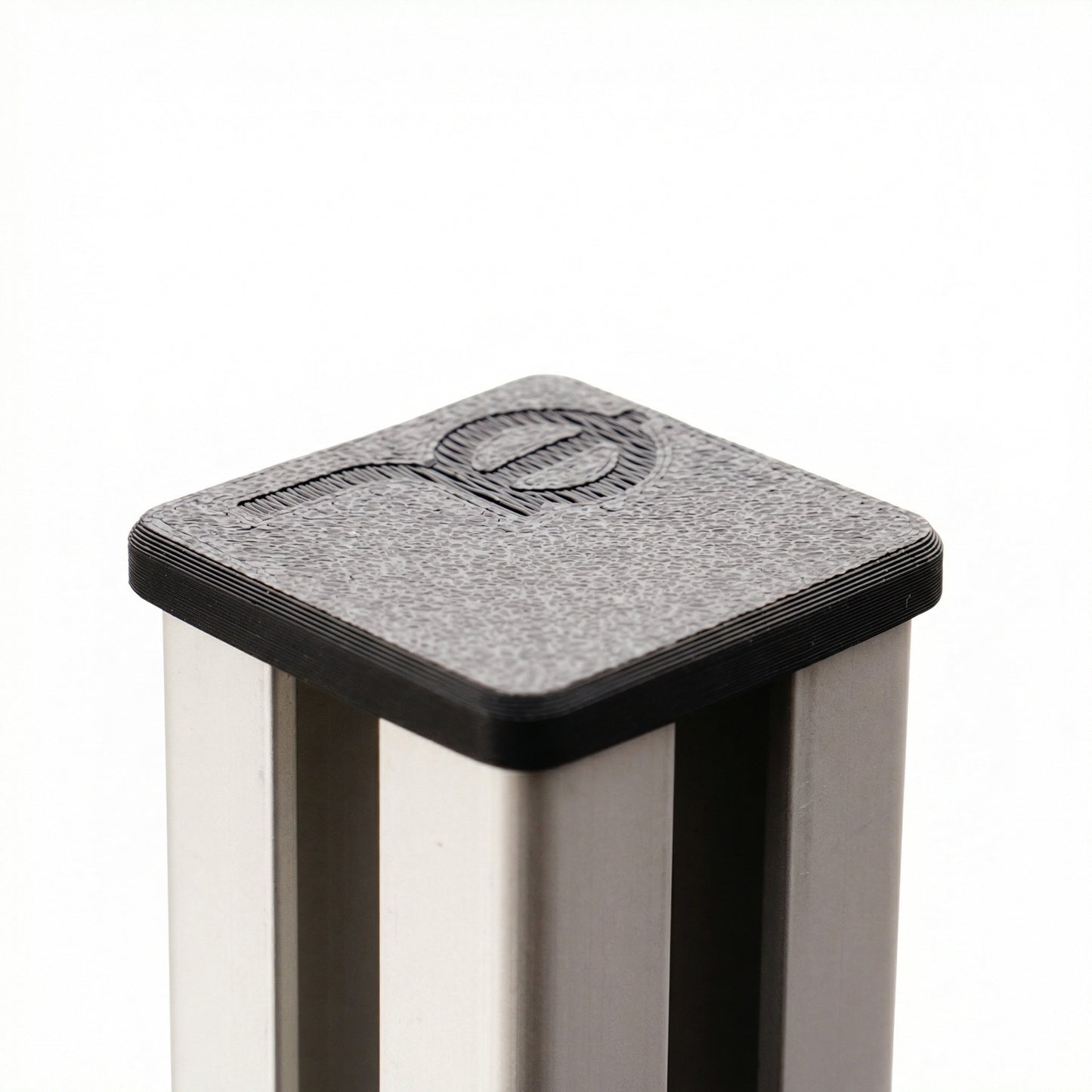
- Takes apart: The profile is bolted to the base; the camera mount is held by a Fast-Lock clamping lever. With the included Allen key, you disassemble the stand for transport or for storage under your desk.
- Set the height once per film format: Loosen the clamping lever on the camera mount, slide the mount along the profile, tighten the lever again; designed for a fixed height per format, not for frequent readjustment during repro work.
- Enough height for medium format: Up to 54 cm of distance between film and sensor is sufficient for 35 mm and roll film up to 6×9 with macro lenses from 50 to 105 mm, and for 4x5 with a 50 or 60 mm macro lens (table below).
Compatibility
- Camera mount: 3/8" tripod thread (compatible with all 3/8" tripod heads and adapter plates)
- Included leveling base (variants “Copy Stand + Leveling Base” and “Copy Stand + Leveling Base + Alignment Mirror”): 1/4" camera screw, fits the standard tripod thread of virtually all cameras
- Sony A7 series (A7 II, A7 III, A7R IV, A7C, …)
- Canon EOS 5D Mark III / IV, Canon EOS R series
- Nikon D810, D850, Nikon Z series (Z5, Z6, Z7, Zf, …)
- Fuji X-T series, X-H series
- Panasonic S series (S1, S5, …)
- Compact medium-format systems (e.g. Hasselblad X1D/X2D: check total weight with lens)
- Macro lenses: 50 mm, 60 mm, 90 mm, 100 mm, 105 mm (and comparable)
- Modular accessories: Film Scanner Holder System, CineStill CS-LITE, alignment mirror (sold separately)
Which film format you can scan depends on the lens focal length. Overview for full-frame sensors and macros up to 1:1, calculated with a maximum distance of 54 cm between film and sensor:
| Film format | Macro focal length | ||||
|---|---|---|---|---|---|
| 50 mm | 60 mm | 90 mm | 100 mm | 105 mm | |
| 35mm | yes 20.0 cm |
yes 24.0 cm |
yes 36.0 cm |
yes 40.0 cm |
yes 42.0 cm |
| 6×4.5 | yes 21.6 cm |
yes 25.9 cm |
yes 38.9 cm |
yes 43.2 cm |
yes 45.4 cm |
| 6×6 | yes 23.8 cm |
yes 28.6 cm |
yes 42.9 cm |
yes 47.6 cm |
yes 50.0 cm |
| 6×7 | yes 23.8 cm |
yes 28.6 cm |
yes 42.9 cm |
yes 47.6 cm |
yes 50.0 cm |
| 6×9 | yes 23.8 cm |
yes 28.6 cm |
yes 42.9 cm |
yes 47.6 cm |
yes 50.0 cm |
| 4×5 | yes 31.1 cm |
yes 37.3 cm |
no 55.9 cm |
no 62.1 cm |
no 65.2 cm |
yes means at least 2 cm of clearance, limited means it just fits, and no means the Copy Stand is too low. The number below the result is the distance between the film and sensor required by the combination.
For Micro Four Thirds, APS-C, and digital medium format from Fujifilm and Hasselblad, the tables with camera names are available on the page Which film format can your camera handle on the Copy Stand?
Scope of delivery
-
Copy Stand (without tripod head):
- 32×32 cm base plate (20 mm film-faced plywood), 4 stick-on rubber feet
- 30×30 mm aluminum profile, 60 cm
- Camera mount with 3/8" tripod thread
- 1× Fast-Lock clamping lever for the camera mount + end cap + mounting hardware (5 M8 screws, 2 T-slot nuts, Allen key) + assembly instructions (DE/EN)
- No tripod head. You need to add one separately (3/8" connection), or you choose the “Copy Stand + Leveling Base” variant
-
Copy Stand + Leveling Base:
- 32×32 cm base plate (20 mm film-faced plywood), 4 stick-on rubber feet
- 30×30 mm aluminum profile, 60 cm
- Camera mount with 3/8" tripod thread
- 1× Fast-Lock clamping lever for the camera mount + end cap + mounting hardware (5 M8 screws, 2 T-slot nuts, Allen key) + assembly instructions (DE/EN)
- 1× leveling base (3/8" connection, 1/4" camera screw, up to 10 kg) with 1/4" to 3/8" adapter screw, hex key, and instructions
-
Copy Stand + Leveling Base + Alignment Mirror:
- 32×32 cm base plate (20 mm film-faced plywood), 4 stick-on rubber feet
- 30×30 mm aluminum profile, 60 cm
- Camera mount with 3/8" tripod thread
- 1× Fast-Lock clamping lever for the camera mount + end cap + mounting hardware (5 M8 screws, 2 T-slot nuts, Allen key) + assembly instructions (DE/EN)
- 1× leveling base (3/8" connection, 1/4" camera screw, up to 10 kg) with 1/4" to 3/8" adapter screw, hex key, and instructions
- 1× 50 × 50 mm alignment mirror, with protective film on both sides
Technical details
- Base plate: 20 mm film-faced plywood, 32 × 32 cm, with CNC-milled profile recess
- Profile: aluminum T-slot 8 (30×30 mm), 60 cm total length
- Distance from film to camera sensor: up to 54 cm (measured with film holder on CineStill CS-LITE and ball head)
- Camera mount: 3/8" thread (professional standard)
- Recommended max. camera load: ~1.5 kg (usable up to ~2 kg with slight flex in the profile)
- Leveling base (variants “Copy Stand + Leveling Base” and “Copy Stand + Leveling Base + Alignment Mirror”): aluminum, 3/8" female thread, screws directly onto the camera mount, 1/4" camera screw, ±15° tilt in any direction, 360° rotation, bubble level, 10 kg load capacity, weight 230 g
- Alignment mirror (only variant “Copy Stand + Leveling Base + Alignment Mirror”): acrylic, mirror-coated, 50 × 50 mm, shatter-resistant
- Clamping system: profile bolted to the base with one M8 screw, camera mount with Fast-Lock clamping lever (one T-slot nut 8 each)
- Mounts: engineering plastic
- Fastening: 4× integrated threaded inserts (M8) in the base plate
- Feet: 4× soft stick-on rubber feet (non-slip, vibration-damping)
- Weight: ~1.9 kg
- Dimensions (L × W × H): 32 × 32 × 62 cm
- Color: Black
Description
The Copy Stand is our camera copy stand for anyone who scans negatives and slides with their own digital camera instead of a flatbed scanner. Its centerpiece is the base plate made from 20 mm film-faced plywood, the same material used for load-bearing floors in exhibition construction. The CNC-milled recess and four threaded inserts keep the profile in position even under load instead of merely screwing it on top. The profile itself is a standard aluminum profile with T-slot 8; if you want to scan larger formats, simply buy a taller profile.
The profile does not have a permanently attached camera holder, but a 3/8" mount. The Copy Stand is designed for use with a tripod head for a technical reason: every copy stand bends slightly under the weight of the camera and lens, even the most stable one, and even light combinations can cause a few tenths of a millimeter of deflection. A tripod head between the Copy Stand and camera compensates for exactly that: attach the head to the 3/8" screw, mount the camera on the head, and use the joint to set the camera exactly parallel to the original. The alignment mirror shows whether it is truly parallel: it sits where the film would normally be, and in Live View you align the reflection of your lens with the center of the image. Use an existing ball head or geared head directly. If you do not have your own head, choose the “Copy Stand + Leveling Base” variant: the leveling base screws onto the camera mount without an adapter, tilts the camera on a hemisphere by up to 15° in any direction, supports 10 kg, and includes the 1/4" screw for your camera’s tripod thread. The “Copy Stand + Leveling Base + Alignment Mirror” variant includes the mirror as well.
With a heavy camera near full height, the profile keeps swaying for a while after adjustment: One user with 1.8 kg of medium format equipment, i.e. above the recommended load, observed 20 to 25 seconds at almost full height. Give the setup a moment to settle after adjusting or release the shutter with the self-timer.
The Copy Stand is the foundation of our film-scanning system. Add a negative holder from the Film Scanner Holder System and a light source for a complete scanning workflow.
If you are unsure which combination suits your setup, the Film Scanner Finder recommends one after three questions. The range diagram shows all components in the layered setup, with clickable direct shop links. You can find guides and technical background on film scanning in our blog overview.



Customer reviews
Based on 2 reviews100% verified reviews
Transparency note: As a thank-you for a published review after an order, we send every customer a discount code for their next order, regardless of the star rating.
Reviews come from customers who ordered the item from us. We send the link by email after shipping; it belongs to exactly one order. That is why every review given this way carries the note “Verified purchase”.
Lost the link? A short message with the order number to info@ausgeknipst.de is enough and we will send it again.
-
Pär H.Verified
Copystand review
Overall a nice piece of equipment. Easily portable .What can be improved?:
* The screw at the bottom of the aluminum profile connecting with the stand as such is pretty fiddly to work with. I don't use it.
* The screw connecting to the equipment is pretty hard to work with, especially as the connecting surface does not have any kind of good friction, making any attached equipment rotate easily.
* Also increase the height of the sliding connector so it does not easily get affected by the weight/momentum of the camera, meaning that it is hard to keep it level. -
L. P.Verified
Simple DIY Setup for hobby purposes
A simply built DIY repro-stand for semi-professional/hobby purposes, but lacking for professional work, the value for its price could be better,
For a simple Film Scanning setup where height is set once and not adjusted much, it gets the job done. Analogue Repro-work is a bit of a pain with this stand.
It is generally sturdy, but not smooth and precise enough to call it professional. Setting the height feels very clunky and unstable, tends to shake the construction, unbalancing fine-adjustments each time. Given that setting a specific height is the purpose of a copy stand, this is a minus in value.
Material quality is generally okay, but lacking in parts. The 3D-printed parts don't move well along the aluminum, and mounting a tripod head is always a pain due to the oversized 3d-printed top of the mounting screw.
While the relatively small base has the advantage of not taking up much space and still being stable, it doesn't provide enough working surface, depending on tripod-head/-plate used (SmallRig Ballhead in my setup). My Cinestill lightbox and essential film holder sit at the edge of the base. For repro-work I mostly have to extend the surface 'creatively'.
Came without any assembly instructions, had to guess my way through. For a DIY-Kit like this, the price should definitely be lower.Reply from Ausgeknipst ·
Thank you for taking the time, this is the most useful review this product has had. Several of your points are already on our list: the sliding block, the friction under the mounting screw and the assembly sheet that should have been in the box in the first place. If you would like to test the improvements, write to info@ausgeknipst.de.
Vladi · Ausgeknipst
No reviews yet. After a purchase we ask for one by email.
After a purchase we ask for a review by email. New reviews appear automatically; we read them afterwards and never remove one because of its star rating. “Verified purchase” means the review came through the review link of an order in our shop. “Verified” marks older reviews that our previous review service, Judge.me, had labelled as verified. Reviews imported from Amazon are labelled and not included in the average. How we collect and check reviews

We are Anto & Vladi
Support a young startup
You want innovative solutions instead of mass-produced goods? With us, you don’t buy from an anonymous wholesaler, but directly from the founders. We (Anto & Vladi) started our startup in 2019 in Würzburg to help you revive analog photography.

Developed by engineers
Designed in Würzburg
We don’t sell anything we wouldn’t use ourselves. We are engineers and camera nerds, and we know that precision is especially important in camera technology. That’s why we design our parts ourselves in Würzburg, and we print and assemble most of them here too. Batteries and rechargeables come from other manufacturers, for example Varta.

From Germany to the whole world
Fast DHL shipping
Don’t want to wait forever for your item? We pack every order in Würzburg and send it out on the next shipping day (Monday, Wednesday or Friday). Within Germany it then arrives in 2-4 days, with DHL or Deutsche Post.
