


Varta V80H Battery & Charger: The PX625 Replacement
Community tip: The idea of using the Varta V80H rechargeable battery as a PX625 replacement comes from Troeszter.net. The construction guide with circuit diagram and component list is available there as a free download. To the construction guide (PDF).
The light meter in your Olympus OM-1 indicates a correct exposure, and yet your photos come back incorrectly exposed: it lies because the compartment no longer holds the battery it was built for. The shutter and film advance work without power; only the metering depends on the PX625, a mercury cell with 1.35 volts that has not been available since the ban. What you put in instead determines every shot: zinc-air or silver oxide in an adapter, or a rechargeable battery without an adapter, and no option is perfect. Calculated over three years, zinc-air in an adapter is the cheapest option with the right voltage for a single camera; with several cameras, the rechargeable battery catches up. This guide explains which cameras are sensitive in the first place and which replacement suits yours.
Table of contents
- Why your old camera exposes incorrectly
- All alternatives compared
- Which MR9 adapter fits your camera?
- What does a PX625 replacement cost after three years?
- Rechargeable battery with USB-C
- What skeptics say
- The original construction guide for DIY enthusiasts
- What testers and customers say
- Frequently asked questions
1. Why your old camera exposes incorrectly
The Rollei 35, the Leica CL, the Olympus OM-1, the Canon F-1, the Minolta SRT series: all legends of analogue photography. And they all have the same problem: the battery they were designed for no longer exists. Mercury button cells have been banned in the EU since October 1, 2015 (Battery Directive 2013/56/EU; in the US, since 1996).
The PX625 was a mercury button cell with exactly 1.35 volts. Not 1.3, not 1.4, but 1.35 V, consistently throughout its entire service life. This stability was why camera manufacturers calibrated the entire light-meter circuit for it.

Since the ban, there have been four major replacement strategies; Chapter 2 compares them. Each has weaknesses. First, the essentials about voltage:
1.5 volts are not “roughly the same”: The difference between 1.35 V and 1.5 V sounds small. But these 0.15 V are enough to make your camera’s light meter read half a stop to, in bright light, two stops off (Chapter 6 explains why). With slide film, that means incorrect exposure. With negative film, the exposure latitude usually saves you, but it is not a reliable system in the long run.

Discharge curves compared: alkaline (orange) drops steeply from 1.5 V. Zinc-air (blue) stays close to the 1.35 V line. Mercury (green) is the original, constant at 1.35 V. NiMH LSD (magenta) starts at ~1.4 V, quickly drops to approx. 1.25 V, then maintains a long, stable plateau at 1.25–1.30 V.
Not every camera responds with the same sensitivity. What matters is whether the device has a so-called bridge circuit (voltage compensation):
| Camera | Bridge circuit? | 1.5 V-tolerant? |
|---|---|---|
| Rollei 35 / 35S / 35T | No | No, shows incorrect readings |
| Leica CL / M5 | No | No, meter cell directly coupled |
| Olympus OM-1 / OM-1n | No | No, off by up to 2/3 of a stop |
| Minolta SRT (101, 303, etc.) | No | No |
| Nikon F (Photomic) | No | No |
| Canon F-1 | No | No, CdS circuit without compensation |
| Pentax Spotmatic SP and SP II (PX400 battery, not PX625) | Yes | Yes, Wheatstone bridge circuit |
| Nikkormat FTN | No | No, uncompensated series circuit |
Cameras with a bridge circuit can cope with 1.5 V just as well as with 1.35 V. The majority of classics, including the Rollei 35 and the Olympus OM-1, need a voltage close to 1.35 V, otherwise the light meter lies.
For two of these cameras, we have dedicated step-by-step guides with photos of the battery compartment: Battery replacement on the Rollei 35, 35S and 35T and Battery replacement on the Canon F-1. This guide compares the solutions that apply to all PX625 cameras.
2. All alternatives compared
There is no perfect PX625 replacement. Every solution is a compromise. Here are the four most common strategies, rated honestly:
| Solution | Voltage | Cost/use | Service life | Rating |
|---|---|---|---|---|
| Alkaline cell V625U (or LR44 in an adapter) | 1.5 V → drops to ~1.0 V | approx. EUR 0.30 to 1.50 | Months to years | 2/5: Cheap, but incorrect voltage |
| Silver-oxide SR43 in the MR9 adapter | ~1.35 V (adapter lowers it) | Adapter EUR 45–60, cell approx. EUR 1.70 | 1–2 years | 3/5: Stable voltage, adapter expensive and often sold out |
| Zinc-air 675 / WeinCell | ~1.35–1.4 V (flat) | 675 cells approx. EUR 0.30–0.50, WeinCell approx. EUR 9 | 675 cells 4–8 weeks, WeinCell 3–6 months (activated) | 3/5: Best voltage, but dries out |
| Varta V80H (LSD NiMH, rechargeable) | ~1.25–1.30 V (stable) | Set with charger EUR 49.95, spare battery EUR 12.95 / under EUR 0.03 per charge | typically 500 full charging cycles | 4/5: Rechargeable, slightly below 1.35 V |
Disclaimer: We sell some of the products that appear here. Even so, the article is meant first and foremost as help and not as a sales pitch.
Which solution is right for whom? Occasional photographer: Our universal adapter with zinc-air batteries is sufficient if you only activate the cell when loading the film, because from then on its clock is ticking. It is inexpensive, the voltage is correct, and one cell lasts several weeks.
Regular user: The V80H with a charger saves you the constant swapping and the battery waste. Charge it once, take photos for weeks, then recharge it.
Cameras with a bridge circuit: Here, even a simple alkaline cell such as the V625U works. With these cameras, the voltage does not matter; the cell just has to fit in the compartment.
The Problem with Zinc-Air (WeinCell & Hearing-Aid Batteries)
Zinc-air cells provide the voltage closest to that of the PX625. That is their major advantage. However, two disadvantages make them impractical for everyday use:
Self-discharge: As soon as you remove the protective film, the battery starts discharging, even when the camera is turned off. A hearing aid cell is dead after four to eight weeks, whether you have taken photos or not. The WeinCell lasts longer; we expect three to six months. If you put the camera away for a few months, the battery will be dead.
Cost: A WeinCell costs around €9 in Germany (Calumet, as of 28.09.2026). With regular use, this adds up to €18 to 36 per year; the calculation is in Chapter 4. Hearing aid batteries (type 675) are cheaper, but often run out after just 3–4 weeks. A trick from the forums: cover three of the four air holes with adhesive tape, and the 675 then lasts 4–6 months at a stable 1.35 V. According to the forums, it works, but it is tinkering that starts all over again with every battery change.
3. Which MR9 adapter fits your camera?
MR9 is not a brand name. It is the old standard designation of the mercury cell in PX625 format: M stands for mercuric oxide, R for round, 9 for the size (Battery designations according to IEC). The same size as an alkaline cell is called LR9, or V625U at Varta, and in shops often also PX625A. Anyone buying a “PX625 battery” today usually gets exactly this 1.5-volt cell. In this system, the type 675 zinc-air hearing aid cell is called PR44. So anyone looking for an “MR9 adapter” is looking for a part that lets a cell available today fit into the PX625 battery compartment.
Two designs are sold under this name that have nothing to do with each other electrically. Anyone who mixes them up pays too much or gets incorrect meter readings.
The voltage-reducing MR-9 from Japan
The original, sold as MR-9, comes from Kanto Camera, a camera repair workshop in Japan, and is distributed in the USA by C.R.I.S. Camera Services. The adapter takes an SR43 silver-oxide cell (also called 386 or 301), which delivers 1.55 V. A small circuit in the ring lowers the voltage to about 1.35 V. Neither supplier states which component does this. In his overview of the mercury problem, F. de Gruijter suspects two germanium diodes in series (“The mercury cell problem and its solutions”, p. 3).

Photo: huzu1959, CC BY 2.0 via Wikimedia Commons
The advantage lies in the cell. Silver oxide keeps its voltage constant until shortly before the end, does not dry out like zinc-air, and loses less than 10% of its capacity per year on the shelf at room temperature (Renata data sheet 386). For cameras that draw at most 200 µA, such as the Rollei 35, de Gruijter considers the adapter a very good solution, as long as the battery compartment can accommodate the adapter's extra 0.38 mm of height.
The drawbacks are mentioned less often in the shops:
- The circuit is built for the tiny currents of a light meter. De Gruijter observes problems from about 200 µA and reports deviations of up to three EV on a Nikon F. For power-hungry devices, Kanto sells a second version with no voltage reduction at all.
- Cameras with a battery check lamp react differently. According to Kanto, the test lamp on the Canon EF does not light up, so the adapter manufacturer advises against it there. The compatibility list from C.R.I.S. (PDF), on the other hand, lists the EF with two adapters. If your camera is on neither list, or is listed with contradictory information on both, ask the dealer before buying.
- You can't test the adapter with a multimeter. The voltage only drops when current flows. A digital multimeter draws almost nothing and therefore shows the cell's full 1.55 V, even though about 1.35 V reaches the camera.
- Price and availability fluctuate. On 28.09.2026 the adapter cost 39.99 dollars at C.R.I.S. and was sold out, as it was at Kamerastore in Finland (45 EUR). The Kanto adapter was available at fotohandel.de for 59.95 EUR, and an adapter of the same type at Jo Geier in Austria for 49.90 EUR. The British Small Battery Company offers its own based on the same principle for 29.43 British pounds including postage.
The video by TechHeritage shows the common options side by side, from minute 6 specifically for the PX625: the alkaline cell in PX625 format, a ring from the hardware store around a smaller cell, brass adapters, the WeinCell and, from minute 15, the MR-9 from Japan. In the video, the MR-9 holds an LR44 alkaline cell. Kanto lists only silver oxide as suitable cells (SR43, 386, 301), and that makes sense: the voltage of an alkaline cell drops over time, and then the precise reduction is of little use.
Video: TechHeritage, “Replacement Batteries for Vintage Cameras” (English), starts at minute 6
Spacer adapters for type 675 zinc-air cells
The second type is often also sold as an MR9 adapter, but has no electronics. Such an adapter simply brings the smaller type 675 hearing aid cell (11.6 mm diameter) up to the size of the PX625 (15.6 mm). The voltage comes from the cell itself: under the tiny load of a light meter, zinc-air delivers between 1.35 and 1.4 V. Which spacer adapter fits depends on where your camera picks up the positive terminal.
- Contact at the top and bottom, as in the Rollei 35, Olympus OM-1, Canon F-1 and Minolta SRT: here an insulating rubber ring that keeps the cell centred is enough. An O-ring measuring 11 × 15 × 2 mm has proven itself, i.e. 11 mm inside, 15 mm outside and 2 mm cord thickness. It sits snugly on the 675, which at 11.6 mm is slightly larger than its inner diameter, and brings it to roughly the diameter of the PX625. You can get a ring like this at the hardware store or as an O-ring assortment from online retailers. Take a 675 with you to try it out: the ring must keep the cell centred, but must not end up larger in diameter than the old PX625. We used to carry exactly this ring ourselves in a set. We are replacing the set with the universal adapter because it also works with side contact.
- Contact at the side on the rim (for example on the Leica CL): an insulating ring covers exactly the spot where the camera looks for the positive terminal, and the light meter shows nothing. Here you need a conductive adapter, such as a simple brass adapter or our universal adapter, whose material itself conducts and passes the contact on across its entire surface.
- Leica M5: the compartment is so tight that the screw cap often won't close over an adapter. Insert the 675 there without an adapter; the cap screws in far enough to make secure contact with it.
The Varta V80H doesn't need any of these adapters. The rechargeable battery is 15.5 mm in diameter and just under 6 mm high (Varta datasheet), the PX625 15.6 × 5.95 mm (Camera-wiki). So the rechargeable battery goes straight into the compartment; more on this in Chapter 5.
If your manual says PX675 instead of PX625, you don't need an adapter at all: the PX675 had the same dimensions as today's type 675 zinc-air cell, 11.6 × 5.4 mm. A 675 or the WeinCell MRB675 goes straight into the compartment (Polar Bear Camera).
4. What does PX625 replacement cost after three years?
One-off prices are misleading with the PX625. In August 2026, a reader from the US worked out for us that our rechargeable battery set, at 59 dollars plus customs and shipping, is the most expensive solution on the shelf there, ahead of the MR-9 adapter (around 40 dollars plus cell) and the WeinCell (9 dollars). That's true. The table shows how things look after a few years.
The table applies to a camera that is used regularly and always has a cell in it. The prices come from shops in Germany and Austria, as of 28.09.2026, excluding shipping. How long a cell lasts depends heavily on the camera and the climate. Where the sources differ, a range is given.
| Solution | Purchase cost | Cells per year | after 1 year | after 3 years | Voltage |
|---|---|---|---|---|---|
| Alkaline cell Varta V625U, without adapter | 1.50 EUR (akkuline) | about 1 | 1.50 EUR | 4.50 EUR | 1.5 V, drops off |
| Zinc-air 675 in a spacer adapter | 22.95 EUR (universal set with 2 adapters and 6 cells) | 6 to 12 (six-pack 1.66 to 2.79 EUR at ewanto and avivamed) | 23 to 26 EUR | 26 to 37 EUR | 1.35 to 1.4 V, flat |
| WeinCell MRB625, without adapter | 8.99 EUR (Calumet) | 2 to 4 | 18 to 36 EUR | 54 to 108 EUR | 1.35 V, flat |
| MR-9 adapter with silver oxide SR43 | 49.90 EUR (Jo Geier) to 59.95 EUR (fotohandel.de), plus the cell from 1.67 EUR (Geizhals) | about 1 | 52 to 62 EUR | 55 to 65 EUR | about 1.35 V, stable |
| Varta V80H rechargeable battery with USB-C charger | 49.95 EUR, with 2 batteries 54.95 EUR (from us) | none | 49.95 EUR | 49.95 EUR | 1.25 to 1.30 V, stable |
Where the cell counts come from: according to Energizer, a zinc-air cell still has 50 % of its capacity 3 to 12 weeks after the tab has been removed, depending on its size (Application Manual Zinc Air, p. 2), hence 6 to 12 hearing aid cells per year. For the WeinCell, Wein stated in 1995 a service life of about three months after activation (article from Popular Photography on the Wein website), later there was talk of up to a year (de Gruijter, p. 2). We assume three to six months. Silver oxide and alkaline cells don't dry out, so we cautiously assume one cell per year. For the rechargeable battery, Varta states 500 full charge cycles or five years (V80H product information).
Among the options with the right voltage, zinc-air in a spacer adapter is the cheapest over three years for a single camera, even cheaper than our rechargeable battery. With an O-ring from the hardware store instead of our set, you even stay under 20 EUR, provided your camera contacts the cell at the top and bottom. The V625U is cheaper still, but delivers the wrong voltage. After three years, the rechargeable battery comes in slightly below the MR-9 and well below the WeinCell.
Things look different as soon as several PX625 cameras are in regular use. One charger is enough for all of them, and each additional camera only adds a spare battery for 12.95 EUR. With zinc-air, MR-9 and WeinCell, on the other hand, you pay again for each camera. With three cameras, the rechargeable route comes to around 68 EUR after three years (set with two batteries plus one spare battery), zinc-air with two universal sets to 58 to 91 EUR, three MR-9s to 165 to 195 EUR and WeinCells to 162 to 324 EUR. After these three years, the rechargeable route costs nothing more until the batteries start to fade after about five years. Zinc-air, on the other hand, needs 18 to 36 new cells every year. Zinc-air with rings from the hardware store remains the cheapest, but in return you change the cells in three cameras every few weeks. The reader who did the maths for us came to the same conclusion for their collection: the rechargeable battery pays off if several PX625 cameras are actually used.
When does the voltage actually matter?
The table is only half the answer. Whether 1.35 V or 1.5 V is supplied matters for cameras whose light meter is connected directly to the battery without a bridge circuit (table in Chapter 1), and most of all with slide film, which has hardly any latitude.
The voltage hardly matters for cameras with a bridge circuit. The best-known example, the older Pentax Spotmatic, doesn't actually take a PX625 at all, but the smaller PX400 (battery for each Pentax model). A simple test shows whether your PX625 camera is one of the insensitive ones: put in a fresh V625U and check a bright and a dark scene against a handheld light meter or a light meter app, because the error caused by excessive voltage is greatest in bright light. If both readings agree to within a third of a stop, the V625U for 1.50 EUR is good enough for you. Repeat the comparison after a few months, because the voltage of the alkaline cell drops over time.
And on many mechanical cameras such as the Rollei 35, Olympus OM-1, Canon F-1 or Nikon F, the battery only powers the light meter. The shutter and film advance work without it. If you work with a handheld light meter or a light meter app anyway, you don't need a battery at all for these cameras. That is the cheapest solution of all.
5. Rechargeable battery with USB-C charger
The Varta V80H is a NiMH button cell (nickel-metal hydride) actually intended as a buffer on circuit boards in servers. But the battery has practically the same dimensions as a PX625 and provides 1.25 to 1.30 V in operation, and even 1.30 to 1.32 V in the first week after charging. Both are close enough to the original 1.35 V to deliver correct exposure readings in most cameras.
Why 1.30 V instead of the nominal 1.2 V? The “1.2 V” on the datasheet is the nominal voltage, a reference value for the middle of the discharge. In practice, a NiMH cell straight off the charger sits at 1.40–1.45 V, drops to approx. 1.30 V in the first few hours, and then maintains a long, flat plateau at 1.25–1.30 V. Only at the very end (the last 10% of capacity) does the voltage drop below 1.2 V. In everyday use, the V80H is therefore much closer to the PX625's 1.35 V than its nominal voltage might suggest.
Why the V80H is not a normal NiMH battery
In forums, you often read: “NiMH batteries discharge quickly; after three weeks, the battery is unreliable.” That's true for standard NiMH batteries from the supermarket. But the V80H is not a standard battery. It belongs to Varta's “Robust” family and is a so-called LSD NiMH battery (Low Self Discharge). This category was specifically developed for applications where the cell must retain its charge for months: real-time clocks in servers, medical measuring devices, backup systems.
The difference from standard NiMH is considerable:
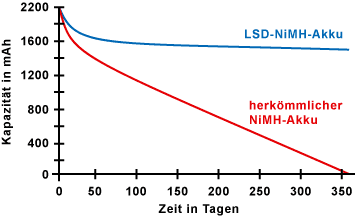
Self-discharge comparison: Standard NiMH batteries (left) quickly lose capacity, while LSD NiMH batteries (right) hold their charge significantly longer. Source: Elektronik-Kompendium.de
The V80H has extremely low self-discharge, similar to the well-known Eneloop batteries. After the first month, it loses hardly any more charge, and most of the capacity is still available after one year of storage at room temperature.
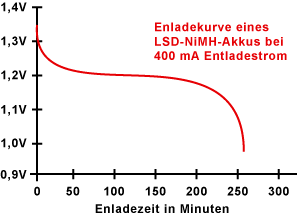
Discharge curve of an LSD NiMH battery: The voltage initially drops from 1.35 V to approx. 1.2 V and then remains stable for hours. With minimal power consumption (as in a light meter), the plateau lasts significantly longer. Source: Elektronik-Kompendium.de
This explains Troeszter's measurements: During discharge under normal load, the voltage of a NiMH battery quickly drops from approx. 1.35 V to ~1.2 V. But then this level remains stable for hours. Because a camera's light meter draws only microamps, this plateau lasts not hours but weeks. Under this tiny load, the voltage is also slightly higher. Troeszter measures 1.30–1.32 V in week 1, then slowly declining to 1.25–1.27 V, where the reading stabilizes and remains there for “several weeks.”

Simply charge overnight

The charger is compact enough for any camera bag. Connect the USB-C cable, insert the V80H, charge overnight, and you're done. The blue LED indicates that charging is in progress. To be completely honest: The LED currently does not indicate when the battery is full; that is planned for version 3. That's why we recommend simply connecting the charger overnight and unplugging it again in the morning. A few extra hours won't harm the battery: in its datasheet, Varta permits overcharging at 14 mA for up to one year at 20 °C, and our charger supplies 12 mA. A full charge takes approximately 9 hours with gentle slow charging (C/7, i.e. one seventh of the capacity per hour). The slow charging is intentional: it significantly extends the battery's service life. Straight out of the package, the batteries are usually only partially charged, so charge them fully once before first use.
Only the V80H belongs in the charger. Smaller NiMH button cells such as the V15H (15 mAh) or V40H (40 mAh) must not be inserted. The charging current is fixed for the V80H's 80 mAh capacity, and the device does not switch off when the cell is full. A V15H receives more than five times the charge rate suitable for it in the charger, and a V40H receives twice as much. Both can overheat and leak.
The V80H fits into the PX625 compartment without an adapter

No adapter, no tinkering. The V80H fits directly into any PX625 battery compartment: insert it, close the cover. It works just as well in the Rollei 35 as in the Leica CL or the Olympus OM-1.
Cameras with the battery compartment inside the film chamber: In some classic cameras, including the Rollei 35 and the Leica CL, the battery compartment is located inside the film chamber. This means that the loaded film has to be removed or shot to the end first every time the battery is changed. With disposable cells, especially zinc-air, changing the battery becomes a logistical problem.
We made the Pro Pack with two batteries precisely for this situation. One is always freshly charged: whenever you change the film, you swap the battery at the same time. No need to open the film chamber again, and no risk to the loaded film. That was one of the main reasons we developed the charger.
Charging on the go: The charger weighs less than 20 grams and fits in your pocket. Combined with a USB-C power bank, you can charge the battery on the go as well. No searching for specialty batteries in unfamiliar cities.
However, the charger draws only 12 mA. Most power banks switch off after 30 seconds at such a low current (auto-shutoff). Your power bank needs a trickle-charge or wearable mode, often activated by double-clicking the power button. Without this mode, the battery will not charge. Newer power supplies with Power Delivery (PD) work similarly: they negotiate the voltage first and then supply no power at all to the tiny load. The most reliable way to charge is with an old, simple USB power supply providing a fixed 5 V, or from a USB port on a laptop.
The Pro Pack with two rechargeable batteries

The Pro Pack contains two V80H rechargeable batteries. One in the camera, one in the charger. So you're covered even on multi-day photo trips; one battery usually lasts two to four weeks of normal photography.
Technical specifications
| Battery type | Varta V80H (LSD NiMH, “Robust” series) |
| Nominal voltage | 1.2 V (according to the manufacturer) |
| Operating voltage (plateau) | 1.25 to 1.30 V |
| First week after charging | 1.30 to 1.32 V |
| Capacity | 80 mAh |
| Charging time | Approx. 9 hours (slow charging at C/7, overnight) |
| Charging cycles | typically 500 full cycles, 1,000 according to the IEC test standard (Varta Robust series, LSD NiMH) |
| Charger connection | USB-C, fixed 5 V without PD negotiation |
| Charger material | Technical plastic |
What is the difference between the Varta V80H and the Varta V625U?
Both come from Varta, both fit into the PX625 compartment, and that is why they are constantly confused. The V625U is an alkaline cell (IEC LR9) with 1.5 V (Varta data sheet) and costs around 1.50 EUR. It thus delivers exactly the 1.5 V that chapter 1 is about: too much voltage, which drops over time. The V80H is a rechargeable battery with a nominal voltage of 1.2 V, which sits at 1.25 to 1.30 V in operation and can be recharged.
If you're looking for an alternative to the V625U, you're really looking for an alternative to the PX625. For cameras with a bridge circuit, the V625U itself is already the answer; for all others, the options from chapters 2 to 4 are.
Which V80H fits in the battery compartment?
Varta builds the V80H mainly as a backup battery for circuit boards. That's why it is also available with solder tabs, with solder pins and as a stack of two or three cells (Varta handbook on NiMH button cells). Only the bare single cell with order number 55608 101 501 fits in a camera. You can also get it from electronics retailers, for example at akkuman.de for 3.95 EUR; from us, the replacement battery costs 12.95 EUR. Pay attention to the current when charging: Varta specifies 7 mA over 14 to 16 hours for standard charging and permits 14 mA over 7 to 8 hours for accelerated charging (V80H data sheet). At 12 mA, our charger sits in between, within the manufacturer's specifications. A charger for AA batteries delivers many times that and is unsuitable for the small cell.
The story behind the PX625 USB-C charger
Lars explains in the video how the charger came about.
6. What skeptics say (and our response)
We would not be honest retailers if we swept criticism under the rug. The analog photography forums contain valid objections to using NiMH batteries as PX625 replacements. Here are the most common ones:
Objection 1: “NiMH batteries only have 1.2 V; that is too low”
A user in the Bilderforum sums it up:
“In the end, this gives you increasing overexposure over time instead of decreasing underexposure over time with 1.5 V solutions. [...] 1.2 V is exactly as far from the required 1.35 V as the 1.5 V of an alkaline battery.”
The calculation is correct: a difference of 0.15 V in either direction if you start from the nominal voltage. In actual operation, things look different. Troeszter measures 1.30–1.32 V in the first week after charging in the Rollei 35. The difference from 1.35 V is then 0.03–0.05 V, less than 1/3 of a stop. Later, the battery sits at 1.25 to 1.27 V, which is up to 0.1 V below the original and thus less than the 0.15 V from chapter 1, and in the direction of overexposure. With negative film and its enormous overexposure latitude, this is not a visible difference.
More decisive is the direction of the deviation. A V80H at 1.30 V causes minimal overexposure, which negative film easily tolerates. An alkaline cell at 1.5 V causes underexposure: barely noticeable in low light (light value EV 6), but up to 2 stops in bright sunlight (EV 15), because the characteristic curve of the CdS metering cell (a light-sensitive resistor) is not linear. With negative film, underexposure is the one direction that really causes problems.
Objection 2: “The battery is empty after a few weeks”
This objection is also frequently raised:
“After three weeks, NI-MHD batteries are already so unreliable in terms of their remaining voltage that only freshly charged, still healthy batteries can actually ensure reliable exposure metering.”
That is true for standard NiMH batteries. Conventional NiMH batteries from supermarkets lose 10 to 20 percent of their charge after just a few days.
However, the V80H is not a standard NiMH battery; it is an LSD NiMH battery (Low Self Discharge), as we explain in chapter 5. LSD NiMH batteries lose approximately 15% in the first month, then almost nothing; after one year, around 80% capacity is still there. Troeszter’s measured values show the same picture:
Long-term measurement by Troeszter.net (Rollei 35T / 35S):
“My experience: When fully charged and inserted into a Rollei 35T or 35S, the V80H battery maintains a voltage of around 1.30 to 1.32 volts for about a week. After a second week, the voltage drops to 1.27 to 1.28 volts. Four weeks after charging, it still has 1.25 to 1.27 volts and maintains this level for several weeks. This solution works very well for me because the light meter delivers identical readings with both a mercury button cell and the V80H battery. I verified this using a test setup (standard light box in a darkened studio).”
Source: Troeszter.net, PX625 battery adapter assembly instructions
In practice, this means charging it overnight before a longer photo outing, after which you have a reliable system. However, if your camera sits in a cupboard for months and you want to head out spontaneously without charging it first, an alkaline battery is still a good choice if you compensate for the metering error with an adjusted ISO setting; we say that openly. The V80H shows its strengths with regular use.
Objection 3: “80 mAh capacity is less than with SR43/SR44”
Mathieu from France writes in his customer review:
“Varta V80H are only 80mAh compared to the 130mAh or more with SR43W and an adapter. [...] I fear i will have to swap them each time I change the roll to avoid loosing metering.”
That's true: 80 mAh sounds low at first. For comparison, an SR43W has 130 mAh, while zinc-air batteries (type 675) have as much as 630 mAh. Without context, however, the figures don't say much. A CdS light meter draws 50–100 microamps. With a capacity of 80 mAh, that theoretically amounts to 800–1,600 hours of active metering time. In practice, the deciding factor is not capacity but how long the cell holds its voltage. And the rechargeable battery has an advantage no disposable cell has: You can recharge the V80H. After 500 cycles, it will have delivered a total of 40,000 mAh, more than any disposable battery ever will.
Objection 4: “The price”
We understand. That's why we offer two starting points: If you only need the correct voltage for now, you get our universal adapter with zinc-air batteries from 22.95 EUR. If you don't want to keep buying batteries in the long term, choose the V80H set. We sell both because different photographers need different solutions. We calculate what both options and the others cost after three years in chapter 4, including for the cases in which the rechargeable battery doesn't come out ahead.
What else you should know
Battery check shows “empty” even though the battery is full: Many cameras (Olympus OM-1, Minolta SRT) have a battery check designed for 1.35 V. With its plateau of 1.25–1.30 V, the V80H almost always ends up in the red zone during the battery check, even though the light meter is working perfectly. This is not a defect. Trust the light meter, not the battery check.
NiMH and winter do not mix: Mercury cells remained voltage-stable even in very low temperatures. NiMH batteries are not. Below 5 °C, the internal resistance of the V80H increases, the voltage plateau dips, and the light meter may give inaccurate readings. If you take photos in winter, keep the camera and battery warm in your jacket pocket. In freezing conditions, a zinc-air cell is the better choice.
Wait 1–2 hours after charging: Right after charging, a NiMH battery has over 1.40 V. If you put it straight into the camera, the light meter measures with too high a voltage and produces incorrect readings. Let the battery rest for 1–2 hours after charging. During this time, the voltage drops to around 1.30 V.
Cameras without a real off switch (Rollei 35 and others): The light meter of the Rollei 35 has no switch and draws power as soon as light falls on the CdS cell, even with the lens retracted. The lens cap doesn't help, because the metering cell has its own window in the body. Only in the dark does practically no current flow anymore (Wikipedia). So between outings, put the camera in your bag or a drawer instead of leaving it out on your desk. Otherwise the light meter will drain the battery even when you aren't taking any pictures at all.
7. The original construction guide for DIY enthusiasts
The idea of using a Varta V80H as a PX625 replacement comes from Troeszter.net. The construction guide published there (freely available as a PDF) shows you how to build your own V80H charger using an adapter made from a wine-bottle closure and a laboratory power supply. If you can solder and enjoy this kind of thing, go ahead, we are deliberately linking to the guide.
Our charger shares the basic idea (V80H + constant-current charging), but takes a different approach: a custom PCB, USB-C instead of a laboratory power supply, and a housing with precision spring contacts instead of copper foil. Troeszter's work was the starting point; the result is an independent product.
The Troeszter solution at a glance
The construction guide describes a homemade charger adapter made from a plastic wine-bottle closure with copper-foil contacts. Troeszter uses an adjustable laboratory power supply as the direct voltage source (set to 1.33–1.37 V). An LM317 regulator is wired as a current limiter: a 100-ohm resistor between OUT and ADJ limits the charging current to approximately 12 mA. The end-of-charge voltage is specified by the power supply and monitored manually; in this configuration, the LM317 regulates only the current, not the voltage.
| Parameter | Details |
| Charging current | 12 mA (regulated by LM317) |
| Final charging voltage (at the battery) | max. 1.37 V (specified by the power supply) |
| Charging time | approx. 9.5 hours |
| Power source | Adjustable laboratory power supply (set to 1.33–1.37 V) |
| Total components | 3 (LM317LP + C1 0.1 µF + R1 100 Ohm) |
| Electronics cost | approx. 1.90 EUR |
What the DIY solution requires: an adjustable laboratory power supply (e.g. Voltcraft), soldering experience, and a multimeter, because you set and monitor the final voltage yourself. Without reverse-polarity protection, inserting the battery incorrectly can damage it. If you have all that, great. For everyone else, there is our ready-made set.
You can find the complete construction instructions, including circuit diagram and photos, as a PDF here: Troeszter.net, PX625 battery adapter construction instructions
A suggestion from the photography forum: Someone there inserts the V80H into a regular AA charger using a wine cork and aluminium-foil contacts. Creative and free, but delicate: a short circuit during insertion is a real risk, and the charging current of an AA charger is far too high for the small cell (Chapter 5). If you want to try it, do so at your own risk.
8. What testers and customers say
Independent video test by Camera Talk
The US-based Camera Talk channel ordered the set without any involvement from us and tried it in four devices: Gossen Super Pilot, Nikon F Photomic, Rollei 35, and Contarex Super. He calculates the voltage deviation from the original mercury cell himself in the video and arrives at 3.7 to 5.5 percent. His verdict: negligible. At minute 14, he explicitly says that he paid for everything himself, without a discount or free sample. We’ll leave his criticism as it stands: the price, and the fact that the LED does not indicate when the battery is fully charged.
Video: Camera Talk, “A Rechargeable Alternative to the Mercury Cell” (English)
Test report on analoge-fotografie.net
Thomas Raatz runs one of Germany’s largest analogue photography websites. We sent him the charger with two batteries for testing, and he labels his article accordingly as advertising. His conclusion: Of all the ways to replace the PX625, this is the simplest, with no tinkering and no significant charge loss while stored. He also mentions two criticisms, and both are valid: Despite the guide groove, the cell can be inserted the wrong way around, and there is no automatic charging cut-off. Read the test report on analoge-fotografie.net
30 reviews, an average of 4.77 out of 5 stars (as of 02.10.2026). Here are some reviews:
Customer test by Sorin (Verified purchase): Sorin checked his camera’s light metering with the V80H rechargeable battery against the Sekonic handheld light meter:
- Voigtländer VF 135: Rechargeable battery inserted (measured: 1.23 V), light meter compared with Sekonic. Result: identical readings.
- “Finally a viable, elegant and reliable solution for the (in)famous PX625 batteries.”

Photo: Sorin, comparison test of V80H vs. Sekonic on the Voigtländer VF 135
Customer test by Harald (Verified purchase): Harald uses a Nikon F, a Canon F-1 and a Pentax Spotmatic F:
- Result: “Everything works perfectly; the light meters show reliable readings.”
- “By the way, it doesn’t have a bridge circuit!” he writes about his Pentax Spotmatic F (unlike the older SP from the table in Chapter 1).

Photo: Harald, V80H in use with Nikon F, Canon F-1 and Pentax Spotmatic F

Customer photo from actual use, V80H rechargeable battery set in action
Customer review from Bill (Verified purchase): “Having a 1.3 V rechargeable 625 battery is a brilliant idea. I have a bunch of cameras in my collection that use the 625 battery; some have been converted to 1.5 V, some haven't. This is the perfect solution for the cameras without voltage conversion.”
Customer review from Jürgen (Verified purchase): “I have many old devices that unfortunately require the old mercury batteries. Until now, I was able to use hearing aid batteries. However, they only last for a limited time and then have to be disposed of. The new Varta rechargeable batteries work perfectly for me. Of course, they eventually run out too, but you can recharge them with the new charger.”
What Reddit says about it
In the r/AnalogCommunity subreddit, the V80H charger was presented by one of the founders of Ausgeknipst personally. The community response was predominantly positive, with individual questions about capacity and price; we answered both above. Several users confirm that the V80H delivers correct exposure readings in their cameras (Rollei 35S, OM-1). The V80H is also discussed as an alternative in English-language forums such as Photrio, where the central question was: “But how do you recharge them?” That is exactly why we built the USB-C charger.
The V80H is discussed on Bilderforum, at APHOG, on Photrio and on Reddit r/AnalogCommunity.
9. Frequently Asked Questions
Which battery replaces the PX625?
The original PX625 was a mercury button cell with a constant 1.35 V, banned in the EU since October 1, 2015. For regular users, a rechargeable Varta V80H is the most convenient solution. The battery delivers 1.25 to 1.30 V and fits directly into the battery compartment without an adapter; it is charged via USB-C. Alternatively, type 675 zinc-air cells work in an adapter, as does an SR43 silver-oxide cell in an adapter that lowers the voltage to 1.35 V using a diode.
What is an MR9 adapter?
MR9 is another name for the PX625 mercury cell. Two types are sold as MR9 adapters: the MR-9 from Kanto with built-in voltage reduction, which brings a silver oxide cell SR43 down from 1.55 V to about 1.35 V and costs 45 to 60 EUR in Europe, and simple spacer adapters without electronics that bring a zinc-air cell type 675 to the PX625 format. Which one suits your camera is explained in chapter 3.
Can I use a Varta V625U instead of the PX625?
Mechanically yes, the V625U has the PX625 format. Electrically, it is an alkaline cell with 1.5 V instead of 1.35 V, and its voltage drops over time. In cameras with a bridge circuit this doesn't matter; in most others the light meter reads incorrectly. Whether yours is one of the sensitive ones can be checked by comparing it with a handheld light meter or a light meter app in bright and in low light. For these cameras, a zinc-air cell type 675 in an adapter, an MR-9 adapter with a silver oxide cell or the Varta V80H rechargeable battery are the better options.
Does a standard 1.5 V battery (LR44/SR44) work in a PX625 camera?
Only with voltage adjustment. A 1.5 V alkaline cell or a 1.55 V silver-oxide cell causes incorrect exposure in many cameras with an unregulated light meter unless the voltage is adjusted. An adapter with built-in voltage reduction (usually a diode circuit) lowers the voltage to the required 1.35 V. A Varta V80H does not require this workaround; it fits directly in the battery compartment and delivers 1.25 to 1.30 V there.
Are 1.2 V NiMH batteries sufficient for a PX625 camera?
Standard NiMH batteries from the supermarket (1.2 V, high self-discharge) are unsuitable. The Varta V80H, on the other hand, is an LSD NiMH battery (Low Self Discharge) from Varta’s Robust family. The nominal voltage matters less than the voltage in use: the V80H is also a 1.2 V NiMH battery, but it stays at 1.25 to 1.30 V for weeks because, as an LSD type, it barely self-discharges. Ordinary NiMH batteries, by contrast, drop off after a few days.
Can I charge a V15H or V40H in the V80H charger?
No. The charger charges at a fixed current designed for the V80H’s 80 mAh, and it does not switch off when the cell is full. With a V15H at 15 mAh, this corresponds to roughly five times the charging rate suitable for it; with a V40H, twice the rate. The cell will overheat and may leak. Charge only the Varta V80H in it.
How long does the Varta V80H last compared with zinc-air batteries?
Zinc-air cells begin discharging as soon as the protective film is removed. A hearing aid cell is empty after four to eight weeks, regardless of how much you have photographed during that time. The WeinCell lasts longer; we expect three to six months. By contrast, you simply recharge the V80H. Less battery waste is produced, and chapter 4 works out what each option costs over three years.
Is the Varta V80H with only 80 mAh not too weak for exposure metering?
A CdS exposure meter draws 50 to 100 microamps, so 80 mAh is enough for many rolls of film per charge. An SR43W does have 130 mAh, but it is disposable. If you need the longest possible runtime per battery change, silver oxide in an MR-9 adapter is the better choice (about one cell per year, chapter 4); for normal use, the V80H is sufficient.
How much does a PX625 replacement solution cost?
There are two ways to get started. If you only need the correct voltage, choose the universal adapter with zinc-air batteries from 22.95 EUR. If you no longer want to keep buying disposable cells, choose the rechargeable V80H set with USB-C charger from 49.95 EUR. We sell both because not everyone needs the same solution. Calculated over three years, zinc-air in an adapter is the cheapest option with the right voltage; the calculation for all options is in chapter 4.
Our PX625 solutions at a glance
Charger + rechargeable battery: V80H set with USB-C (49.95 EUR) · Varta V80H replacement rechargeable battery (NiMH) (12.95 EUR) · PX625 universal adapter with batteries (22.95 EUR) · Battery compartment tool (1.7 mm steel) (19.95 EUR)
Further sources
These three overviews also describe solutions we don't offer, such as recalibrating the light meter to silver oxide cells.
- Mercury oxide battery problem (buhla.de), German overview covering recalibration, diode adapters and zinc-air cells
- Mercury battery (English Wikipedia), discharge curve, bans in the EU and USA, replacement solutions for photographers
- The mercury cell problem and its solutions (F. de Gruijter, as a PDF at butkus.org), English overview with measurements on diode adapters, zinc-air cells and a long list of cameras
All PX625 solutions at a glance Adapters, rechargeable batteries, and tools, everything you need to power your analogue camera. View the PX625 range.
More instructions and guides Our blog articles help you get the most out of your analogue camera. All blog articles.
Who is behind Ausgeknipst? We are Anto and Vladi from Würzburg. Engineers, analogue photographers, and convinced that technology should solve problems, not create new ones. About us.

2 comments
Where can I buy one of your chargers? Thanks.
A brilliant guide! The V80H solution is clearly the most robust and environmentally friendly way to keep these classic cameras accurate. As an Electrical Engineering student at Telkom University Surabaya, thank you for documenting the voltage stability and discharge characteristics so clearly it’s invaluable for the analog community