



6-bit encoder kit for Leica M lenses, Leica SL
6-bit encoder kit for Leica M lenses, Leica SL
Availability for pickups could not be loaded
 Anton L.VerifiedKamera hat Objektiv sofort erkanntSchablone an Zeiss Biogon Objektiv mit Leica L to M - Objektiv an CL und SL2 sofort richtig erkannt - Stift funktioniert auch, zumindest bei mir!
Peter W.VerifiedGeometrie nicht genau genugDie Form der Schablone ist ungenau, zumindest an den drei Linsen von Voigtländer und Thypoch, mit denen ich es probiert habe. Die Nase sitzt falsch und auch der Durchmesser stimmt…
HorstVerified6-Bit EncoderSchnelle Lieferung. Alles gut bis auf die Blendenwerte die stimmen nicht immer.
TorstenVerifiedEinwandfrei und sehr schnelle LieferungDas Teil tut, was es soll. Sonntag bestellt, Dienstag Ware erhalten. Super!
Anton L.VerifiedKamera hat Objektiv sofort erkanntSchablone an Zeiss Biogon Objektiv mit Leica L to M - Objektiv an CL und SL2 sofort richtig erkannt - Stift funktioniert auch, zumindest bei mir!
Peter W.VerifiedGeometrie nicht genau genugDie Form der Schablone ist ungenau, zumindest an den drei Linsen von Voigtländer und Thypoch, mit denen ich es probiert habe. Die Nase sitzt falsch und auch der Durchmesser stimmt…
HorstVerified6-Bit EncoderSchnelle Lieferung. Alles gut bis auf die Blendenwerte die stimmen nicht immer.
TorstenVerifiedEinwandfrei und sehr schnelle LieferungDas Teil tut, was es soll. Sonntag bestellt, Dienstag Ware erhalten. Super!
Free shipping in Germany
Free shipping in Germany
With free shipping to your home in 2-4 days.
30-day money-back guarantee
30-day money-back guarantee
You can test any product for 30 days. If you are not satisfied, we will refund the full purchase price including shipping costs. No ifs, ands, or buts.
Your legal guarantee rights
Your legal guarantee rights

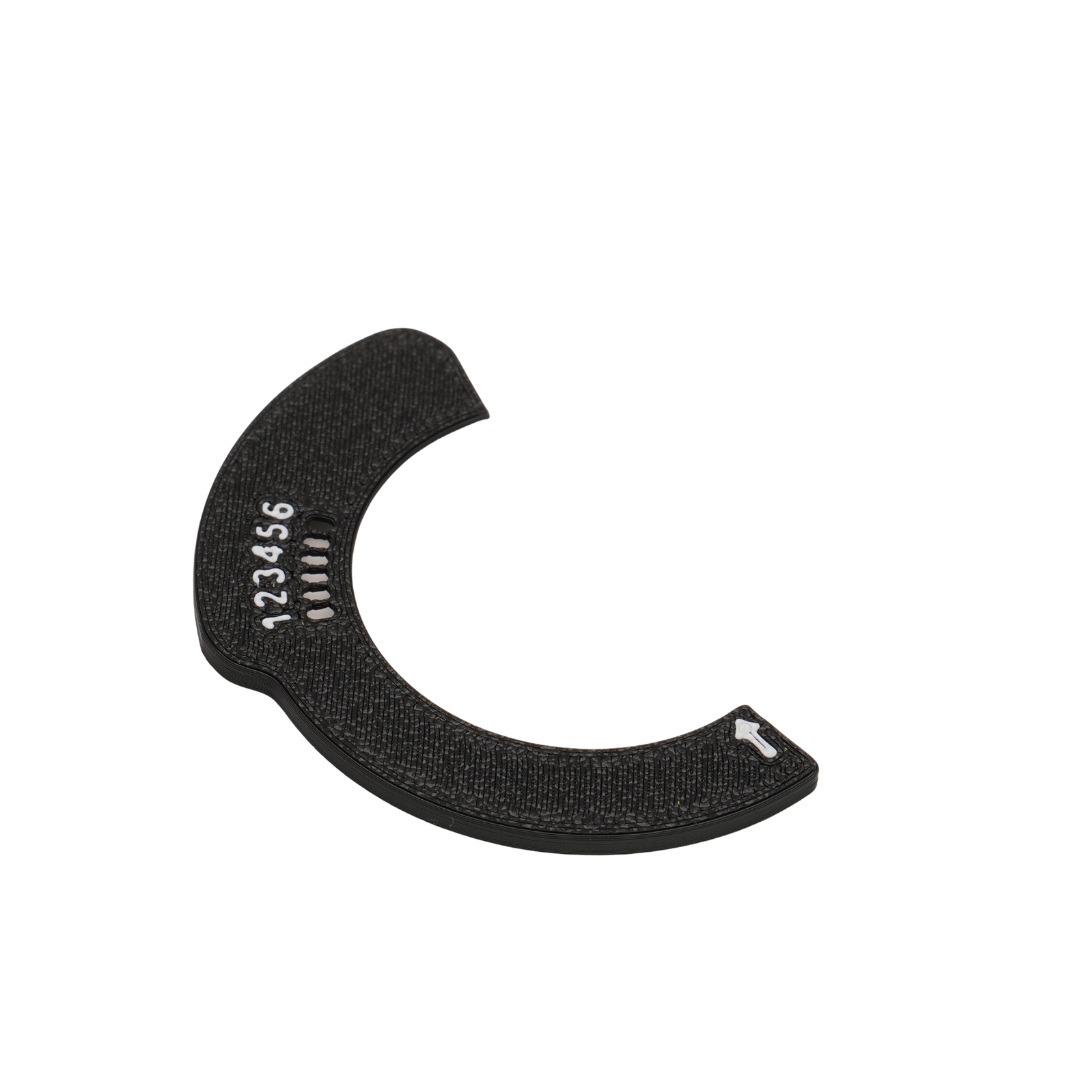
- Lets the camera recognize the lens: You code your manual lens yourself. Your digital Leica then knows which focal length is mounted, without you having to set it by hand every time you change lenses.
- Affordable alternative to other coding methods: Clip it on, fill it in, let it dry. That's all there is to coding it yourself.
- EXIF data and image corrections included: The camera saves the focal length and lens in the metadata and applies vignetting and distortion correction.
- Important for image stabilization: On the SL2 and SL3, IBIS only works accurately with the correct focal length stored.
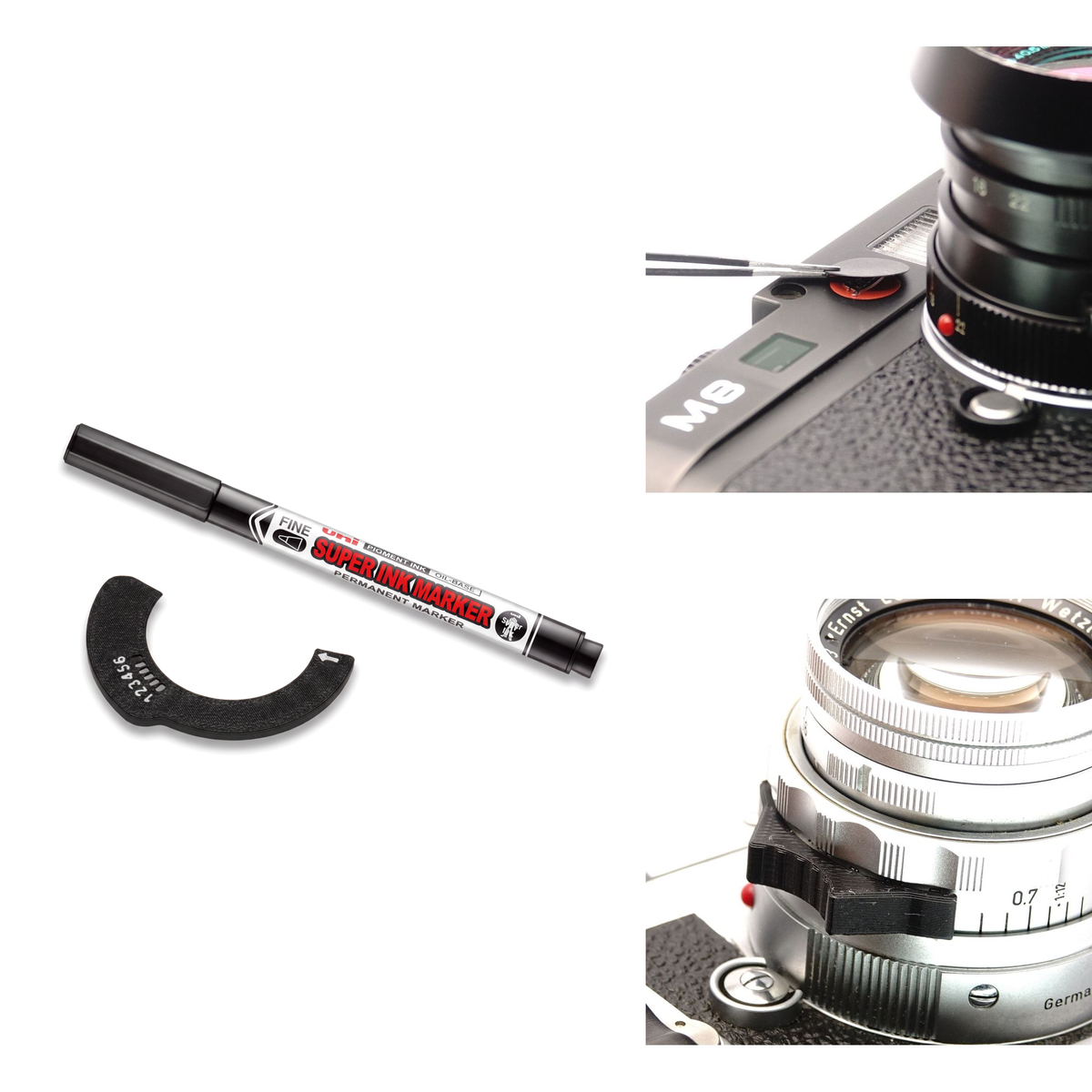
- Matching pen included: The included uni Super Ink Marker PNA-125 has a fine bullet tip that fits through the openings in the template. The camera reliably detects the code drawn with it.
- Clip-on template, no drilling: The encoder clips onto the mount and serves as a template for filling in the dots; the coding can be removed without residue if needed.
Compatibility
Fits all lenses with a Leica M mount, whether older Leica, Voigtländer or Zeiss. On the camera side, all digital Leica M models as well as the SL, CL and TL with M-Adapter L read the code. Current Leica lenses are coded from the factory. You can find the code for your lens in the coding tables below, for Voigtländer, Zeiss and other manufacturers in a separate table.
Scope of delivery
- Standard: 1x 6-bit encoder kit + 1x uni Super Ink Marker PNA-125 (black)
- Set: Standard + 1x red dot cover (set of 2)
- Complete: Set + 1x Quick Focus Tab
Technical details
- Encoder material: engineering plastic
- Pen: uni Super Ink Marker PNA-125, black, bullet tip, line width 0.9 mm, oil-based pigment ink
- Fit: designed for Leica M mounts
- Manufacturing: Made in Germany
Description
With this encoder kit, you handle the Leica 6-bit coding yourself and code your manual M-mount lenses, whether older Leica, Voigtländer or Zeiss. Your digital Leica (M directly, SL, CL and TL via M-Adapter L) then recognizes the focal length, saves it in the EXIF data and applies internal image corrections.
We've learned from our customers when it comes to the pen. Glossy ink can reflect the light from the sensors in the mount instead of absorbing it, and then the camera reads “white” instead of “black”. And with the pen we used to include, the tip was too wide: it didn't fit cleanly through the openings in the template and frayed after just a few lenses. After testing several pens, we now include the uni Super Ink Marker PNA-125. Its fine bullet tip goes through the openings, and the camera reliably detects the code drawn with it.
The encoder clips onto the mount and serves as a template for filling in the dots, without drilling. The coding holds up in everyday use and can be removed without residue if needed.
Tip: If there's a screw at a coding position, the camera may read it as black. If the field should be black, simply paint over it. If it should be white, you're better off using the code of a Leica lens with the same frame whose code is black at this position.
Coding instructions
In the guide, we show you how to use the encoder, which codes match your lens and what you need to watch out for: Coding Leica M lenses.
We also show the whole process in a video, from fitting the template to the test on the Leica M8 (just under 9 minutes, in English with subtitles): Video guide on YouTube.
Coding table
Find your lens in the table. Voigtländer, Zeiss and other manufacturers are listed in a separate table further down.
Legend: □ = leave white (no paint, bare metal), ■ = paint black. The six boxes stand for fields 1 to 6 in order.
Both tables together with step-by-step instructions are available as a printable PDF on the downloads page, in case you want to check it right at the lens while coding.
| Lens | Code | Pattern | Frame lines |
|---|---|---|---|
| Tri-Elmar-M 16-18-21mm f/4 | 010000 | □■□□□□ | 28/90 |
| Super-Elmar-M 18mm f/3.8 | 110100 | ■■□■□□ | 50/75 |
| Summilux-M 21mm f/1.4 | 101111 | ■□■■■■ | 28/90 |
| Elmarit-M 21mm f/2.8 | 000001 | □□□□□■ | 28/90 |
| Elmarit-M 21mm f/2.8 ASPH | 011000 | □■■□□□ | 28/90 |
| Super-Elmar-M 21mm f/3.4 | 110011 | ■■□□■■ | 28/90 |
| Summilux-M 24mm f/1.4 | 110000 | ■■□□□□ | 24/35 |
| Elmarit-M 24mm f/2.8 ASPH | 011001 | □■■□□■ | 24/35 |
| Elmar-M 24mm f/3.8 ASPH | 110010 | ■■□□■□ | 24/35 |
| Tri-Elmar-M 28-35-50mm f/4 | 101010 | ■□■□■□ | 28/90 |
| Summilux-M 28mm f/1.4 ASPH | 110110 | ■■□■■□ | none |
| Summicron-M 28mm f/2 ASPH | 011010 | □■■□■□ | 28/90 |
| Elmarit-M 28mm f/2.8 (III) | 000011 | □□□□■■ | 28/90 |
| Elmarit-M 28mm f/2.8 (IV) | 011011 | □■■□■■ | 28/90 |
| Elmarit-M 28mm f/2.8 ASPH | 011100 | □■■■□□ | 28/90 |
| Summaron-M 28mm f/5.6 | 001011 | □□■□■■ | 28/90 |
| Summilux-M 35mm f/1.4 ASPH (FLE) | 011101 | □■■■□■ | 35/135 |
| Summicron-M 35mm f/2 (IV) | 000110 | □□□■■□ | 35/135 |
| APO-Summicron-M 35mm f/2 ASPH | 001101 | □□■■□■ | 35/135 |
| Summicron-M 35mm f/2 ASPH | 011110 | □■■■■□ | 35/135 |
| Summarit-M 35mm f/2.4 | 010001 | □■□□□■ | 35/135 |
| Summarit-M 35mm f/2.5 | 101011 | ■□■□■■ | 35/135 |
| Noctilux-M 50mm f/0.95 ASPH | 110001 | ■■□□□■ | 50/75 |
| Noctilux-M 50mm f/1 | 011111 | □■■■■■ | 50/75 |
| Noctilux-M 50mm f/1.2 ASPH | 001110 | □□■■■□ | 50/75 |
| Summilux-M 50mm f/1.4 (II) | 000101 | □□□■□■ | 50/75 |
| Summilux-M 50mm f/1.4 ASPH | 100000 | ■□□□□□ | 50/75 |
| Summicron-M 50mm f/2 (III) | 010111 | □■□■■■ | 50/75 |
| Summicron-M 50mm f/2 (IV/V) | 100001 | ■□□□□■ | 50/75 |
| APO-Summicron-M 50mm f/2 ASPH | 101001 | ■□■□□■ | 50/75 |
| Summarit-M 50mm f/2.4 | 010010 | □■□□■□ | 50/75 |
| Summarit-M 50mm f/2.5 | 101100 | ■□■■□□ | 50/75 |
| Elmar-M 50mm f/2.8 | 100010 | ■□□□■□ | 50/75 |
| Noctilux-M 75mm f/1.25 | 111010 | ■■■□■□ | 50/75 |
| Summilux-M 75mm f/1.4 | 100011 | ■□□□■■ | 50/75 |
| APO-Summicron-M 75mm f/2 ASPH | 100100 | ■□□■□□ | 50/75 |
| Summarit-M 75mm f/2.4 | 010011 | □■□□■■ | 50/75 |
| Summarit-M 75mm f/2.5 | 101101 | ■□■■□■ | 50/75 |
| Summilux-M 90mm f/1.5 | 111011 | ■■■□■■ | 28/90 |
| Summicron-M 90mm f/2 (II) | 000111 | □□□■■■ | 28/90 |
| APO-Summicron-M 90mm f/2 ASPH | 100101 | ■□□■□■ | 28/90 |
| Summarit-M 90mm f/2.4 | 010100 | □■□■□□ | 28/90 |
| Summarit-M 90mm f/2.5 | 101110 | ■□■■■□ | 28/90 |
| Tele-Elmarit-M 90mm f/2.8 (II) | 000100 | □□□■□□ | 28/90 |
| Elmarit-M 90mm f/2.8 | 100110 | ■□□■■□ | 28/90 |
| Macro-Elmar-M 90mm f/4 | 100111 | ■□□■■■ | 28/90 |
| Elmarit-M 135mm f/2.8 (I/II) | 001001 | □□■□□■ | 28/90 |
| APO-Telyt-M 135mm f/3.4 | 110101 | ■■□■□■ | 35/135 |
| Macro-Adapter-M | 101000 | ■□■□□□ | none |
Special cases: Summilux-M 35 f/1.4 pre-ASPH, including the original “Steel Rim”: code as Summicron-M 35 f/2 (IV) (000110); the 2022 reissue of the Steel Rim is coded from the factory. Thambar-M 90 f/2.2 (soft focus): best left uncoded or coded as Elmarit-M 90 f/2.8 (100110). Current Leica lenses are coded from the factory. Source: lavidaleica.com / Match Technical (community data, no guarantee).
Third-party lenses
Voigtländer, Zeiss and most other manufacturers ship their M lenses without a 6-bit code. You then paint on the code of a Leica lens. The frame line is what matters: the camera reads the code together with the frame line your lens brings up in the viewfinder and only recognizes it if both match. That is why 40 mm lenses like the Voigtländer Nokton classic 40mm f/1.4 get a 50 mm code: on the Leica M they bring up the 50 mm frame line. The image data will then show the Leica lens from the table.
If your lens isn't in the table, pick one from the Leica table with the same frame line, then with the closest possible focal length and maximum aperture, if in doubt the larger one. Preferably pick an older Leica model: older cameras don't always recognize the codes of very new lenses.
| Lens | Code as | Code | Pattern | Frame line |
|---|---|---|---|---|
| Voigtländer Super Wide-Heliar 15mm f/4.52 | Tri-Elmar-M 16-18-21mm f/4 | 010000 | □■□□□□ | 28/90 |
| Voigtländer Nokton 21mm f/1.4 · Ultron 21mm f/1.8 | Summilux-M 21mm f/1.4 | 101111 | ■□■■■■ | 28/90 |
| Voigtländer Color-Skopar 21mm f/4 · f/3.5 | Elmarit-M 21mm f/2.8 ASPH | 011000 | □■■□□□ | 28/90 |
| Voigtländer Color-Skopar 28mm f/2.8 | Elmarit-M 28mm f/2.8 ASPH | 011100 | □■■■□□ | 28/90 |
| Voigtländer Ultron 28mm f/2 · APO-Lanthar 28mm f/2 | Summicron-M 28mm f/2 ASPH | 011010 | □■■□■□ | 28/90 |
| Voigtländer Nokton 28mm f/1.5 | Summicron-M 28mm f/2 ASPH | 011010 | □■■□■□ | 28/90 |
| Voigtländer Color-Skopar 35mm f/2.5 | Summarit-M 35mm f/2.5 | 101011 | ■□■□■■ | 35/135 |
| Voigtländer Ultron 35mm f/1.7 | Summicron-M 35mm f/2 (IV) | 000110 | □□□■■□ | 35/135 |
| Voigtländer Ultron 35mm f/2 · APO-Lanthar 35mm f/2 | Summicron-M 35mm f/2 ASPH | 011110 | □■■■■□ | 35/135 |
| Voigtländer Nokton 35mm f/1.2 · f/1.4 · f/1.5 | Summilux-M 35mm f/1.4 ASPH (FLE) | 011101 | □■■■□■ | 35/135 |
| Voigtländer Nokton classic 40mm f/1.4 · Nokton 40mm f/1.21, 4 | Noctilux-M 50mm f/1 | 011111 | □■■■■■ | 50/75 |
| Voigtländer Nokton 50mm f/1.2 · f/1.5 | Summilux-M 50mm f/1.4 ASPH | 100000 | ■□□□□□ | 50/75 |
| Voigtländer Nokton 50mm f/1 · f/1.1 | Noctilux-M 50mm f/1 | 011111 | □■■■■■ | 50/75 |
| Voigtländer APO-Lanthar 50mm f/2 | APO-Summicron-M 50mm f/2 ASPH | 101001 | ■□■□□■ | 50/75 |
| Voigtländer Color-Skopar 50mm f/2.5 | Summarit-M 50mm f/2.5 | 101100 | ■□■■□□ | 50/75 |
| Voigtländer Nokton 75mm f/1.5 | Summilux-M 75mm f/1.4 | 100011 | ■□□□■■ | 50/75 |
| Voigtländer Ultron 75mm f/1.9 · Heliar 75mm f/1.8 | Summilux-M 75mm f/1.4 | 100011 | ■□□□■■ | 50/75 |
| Voigtländer Color-Heliar 75mm f/2.5 · APO-Skopar 75mm f/2.8 | Summarit-M 75mm f/2.5 | 101101 | ■□■■□■ | 50/75 |
| Voigtländer APO-Skopar 90mm f/2.8 | Elmarit-M 90mm f/2.8 | 100110 | ■□□■■□ | 28/90 |
| Voigtländer APO-Ultron 90mm f/2 | APO-Summicron-M 90mm f/2 ASPH | 100101 | ■□□■□■ | 28/90 |
| Zeiss Biogon 21mm f/2.8 | Elmarit-M 21mm f/2.8 | 000001 | □□□□□■ | 28/90 |
| Zeiss Biogon 25mm f/2.8 (with 35mm frame lines) | Elmarit-M 24mm f/2.8 ASPH | 011001 | □■■□□■ | 35/135 |
| Zeiss Biogon 25mm f/2.8 (with 28mm framelines) | Elmarit-M 28mm f/2.8 ASPH | 011100 | □■■■□□ | 28/90 |
| Zeiss Biogon 28mm f/2.8 | Elmarit-M 28mm f/2.8 ASPH | 011100 | □■■■□□ | 28/90 |
| Zeiss Biogon 35mm f/2 | Summicron-M 35mm f/2 (IV) | 000110 | □□□■■□ | 35/135 |
| Zeiss C Biogon 35mm f/2.8 | Summarit-M 35mm f/2.5 | 101011 | ■□■□■■ | 35/135 |
| Zeiss Distagon 35mm f/1.4 | Summilux-M 35mm f/1.4 ASPH (FLE) | 011101 | □■■■□■ | 35/135 |
| Zeiss Planar 50mm f/2 | Summicron-M 50mm f/2 (IV/V) | 100001 | ■□□□□■ | 50/75 |
| Zeiss C Sonnar 50mm f/1.5 | Summilux-M 50mm f/1.4 ASPH | 100000 | ■□□□□□ | 50/75 |
| Zeiss Sonnar 85mm f/2 | APO-Summicron-M 90mm f/2 ASPH | 100101 | ■□□■□■ | 28/90 |
| Zeiss Tele-Tessar 85mm f/4 | Macro-Elmar-M 90mm f/4 | 100111 | ■□□■■■ | 28/90 |
| Thypoch Simera 21mm f/1.4 · TTArtisan 21mm f/1.5 | Summilux-M 21mm f/1.4 | 101111 | ■□■■■■ | 28/90 |
| Thypoch Simera 28mm f/1.4 | Summicron-M 28mm f/2 ASPH | 011010 | □■■□■□ | 28/90 |
| Thypoch Simera, TTArtisan, 7Artisans 35mm f/1.4 | Summilux-M 35mm f/1.4 ASPH (FLE) | 011101 | □■■■□■ | 35/135 |
| Light Lens Lab 35mm f/1.4 “AA” | Summilux-M 35mm f/1.4 ASPH (FLE) | 011101 | □■■■□■ | 35/135 |
| Light Lens Lab 35mm f/2 “8 Elements” | Summicron-M 35mm f/2 (IV) | 000110 | □□□■■□ | 35/135 |
| TTArtisan 35mm f/2 · 7Artisans 35mm f/23 | Summicron-M 35mm f/2 ASPH | 011110 | □■■■■□ | 35/135 |
| Thypoch Simera, TTArtisan 50mm f/1.4 | Summilux-M 50mm f/1.4 ASPH | 100000 | ■□□□□□ | 50/75 |
| TTArtisan, 7Artisans 50mm f/0.95 | Noctilux-M 50mm f/0.95 ASPH | 110001 | ■■□□□■ | 50/75 |
| 7Artisans 50mm f/1.13 | Noctilux-M 50mm f/1 | 011111 | □■■■■■ | 50/75 |
| TTArtisan 50mm f/2 · Light Lens Lab 50mm f/2 | Summicron-M 50mm f/2 (IV/V) | 100001 | ■□□□□■ | 50/75 |
| Thypoch Simera 75mm f/1.4 | Summilux-M 75mm f/1.4 | 100011 | ■□□□■■ | 50/75 |
| Konica M-Hexanon 28mm f/2.8 | Elmarit-M 28mm f/2.8 ASPH | 011100 | □■■■□□ | 28/90 |
| Konica M-Hexanon 35mm f/2 | Summicron-M 35mm f/2 ASPH | 011110 | □■■■■□ | 35/135 |
| Konica M-Hexanon 50mm f/2 | Summicron-M 50mm f/2 (III) | 010111 | □■□■■■ | 50/75 |
| Leica Summicron-C 40mm f/2 · Minolta M-Rokkor 40mm f/21 | Summicron-M 50mm f/2 (IV/V) | 100001 | ■□□□□■ | 50/75 |
1 40 mm lenses bring up the 50 mm frame on the Leica M, hence the 50 mm code. The image data then shows 50 mm. 2 With the code of the Tri-Elmar 16-18-21, the lens does not transmit a focal length to the camera. 3 Early series came with exactly this code from the factory. 4 Nokton classic 40: on some copies there is a screw under fields 5 and 6, and the camera then reads field 5 as black. The Noctilux code is black there anyway and therefore works with or without the screw. Tested on a Leica M8.
Black-painted mount, as on some black Voigtländer lenses: in that case the white fields need white paint, otherwise the camera reads them as black. Sources: Zeiss recommendation list for ZM lenses, lavidaleica.com and experience from Leica forums, without guarantee.



Customer reviews
Based on 15 reviews100% verified reviews
Transparency note: As a thank-you for a published review after an order, we send every customer a discount code for their next order, regardless of the star rating.
Reviews come from customers who ordered the item from us. We send the link by email after shipping; it belongs to exactly one order. That is why every review given this way carries the note “Verified purchase”.
Lost the link? A short message with the order number to info@ausgeknipst.de is enough and we will send it again.
Customer photos and videos
-
Anton L.Verified
Kamera hat Objektiv sofort erkannt
Schablone an Zeiss Biogon Objektiv mit Leica L to M - Objektiv an CL und SL2 sofort richtig erkannt - Stift funktioniert auch, zumindest bei mir!
-
Dieter H.Verified
Super Betreuung, sehr gerne wieder !
Das ganze Team
-
John S.Verified
Precision Made!
Very well-made, with a precise fit on my lenses. Instructions and coding guide were especially helpful.
-
TorstenVerified
Einwandfrei und sehr schnelle Lieferung
Das Teil tut, was es soll.
Sonntag bestellt, Dienstag Ware erhalten. Super! -
Gerhard P.Verified
Hilfreiches Tool
Prompte Lieferung, einfache Handhabung.
Funktioniert und bietet eine günstige Alternative zu anderen Verfahren. Die Markierung sieht zwar etwas „primitiv“ auf den Objektiven aus, aber es funktioniert. Das ist die Hauptsache! -
Manfred M.Verified
Alles gut !
-
Martin V.Verified
6 Bit Encoder
Schablone funktioniert und tut was sie soll. Hilfreich gegen das Vergessen der manuellen Einstellung bei älteren uncodierten Objektiven. Kaufabwicklung prompt und problemlos. Gesamteindruck: Tip-Top und empfehlenswert!
-
6bitVerified
Alles wie versprochen - sicher ein Nischenprodukt, aber äußerst nützlich!
-
Hans P.Verified
Smartes Tool
Funktioniert, habe ein paar alte Schätzchen erfolgreich codiert.
-
Peter W.Verified
Geometrie nicht genau genug
Die Form der Schablone ist ungenau, zumindest an den drei Linsen von Voigtländer und Thypoch, mit denen ich es probiert habe. Die Nase sitzt falsch und auch der Durchmesser stimmt nicht. Auch die „Anprobe“ an einer Original Leica Linse zeigt, dass die Abmessungen nicht stimmen.
Ursprüngliche Bewertung waren 2 Sterne. Der Hersteller hat mit mir Kontakt aufgenommen und eine verbesserte Version versprochen. Mein Geld habe ich ungefragt zurück bekommen.Reply from Ausgeknipst ·
Hallo Peter, danke für die genaue Beschreibung. Tut mir leid, dass die Schablone an deinen Objektiven weder mit der Nase noch im Durchmesser sauber sitzt. Wir lassen die Passform nachprüfen. Wenn du danach eine neue Schablone möchtest oder lieber dein Geld gegen Rücksendung, schreib uns an info@ausgeknipst.de.
Vladi · Ausgeknipst
No reviews yet. After a purchase we ask for one by email.
After a purchase we ask for a review by email. New reviews appear automatically; we read them afterwards and never remove one because of its star rating. “Verified purchase” means the review came through the review link of an order in our shop. “Verified” marks older reviews that our previous review service, Judge.me, had labelled as verified. Reviews imported from Amazon are labelled and not included in the average. How we collect and check reviews

We are Anto & Vladi
Support a young startup
You want innovative solutions instead of mass-produced goods? With us, you don’t buy from an anonymous wholesaler, but directly from the founders. We (Anto & Vladi) started our startup in 2019 in Würzburg to help you revive analog photography.

Developed by engineers
Designed in Würzburg
We don’t sell anything we wouldn’t use ourselves. We are engineers and camera nerds, and we know that precision is especially important in camera technology. That’s why we design our parts ourselves in Würzburg, and we print and assemble most of them here too. Batteries and rechargeables come from other manufacturers, for example Varta.

From Germany to the whole world
Fast DHL shipping
Don’t want to wait forever for your item? We pack every order in Würzburg and send it out on the next shipping day (Monday, Wednesday or Friday). Within Germany it then arrives in 2-4 days, with DHL or Deutsche Post.
