

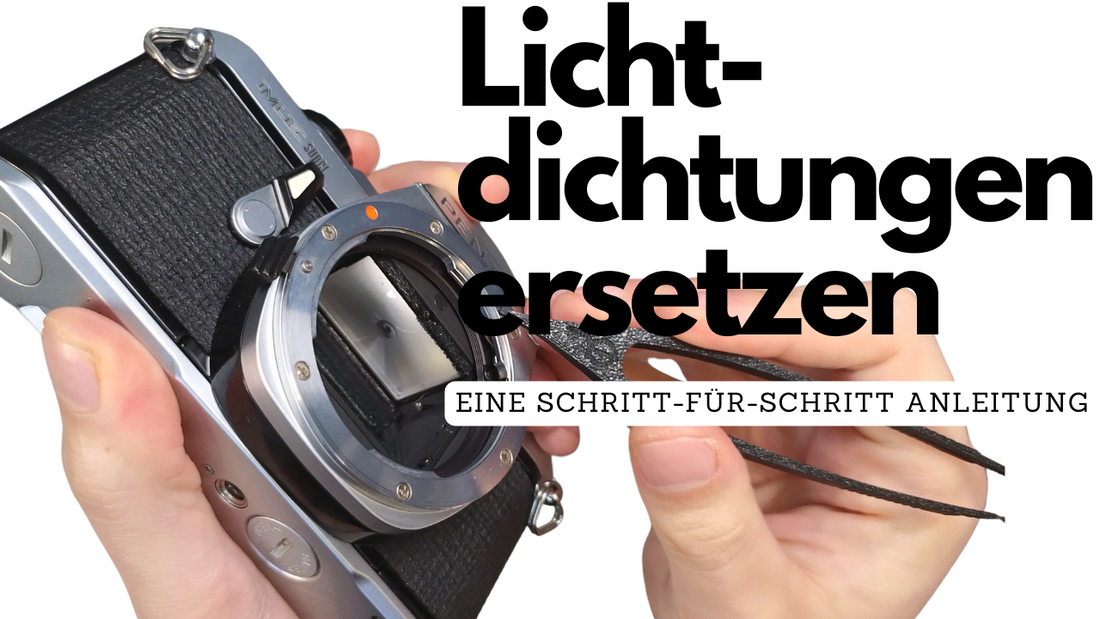
Film Camera Light Seals: How to Replace Them Yourself
The following video (in English, with German subtitles) shows the process in detail:
If you own one or more film cameras, there’s a good chance that the light seals in one or all of them need to be replaced.
Over time, these small foam strips deteriorate and can cause light leaks that may completely ruin your photos in the worst case. In any event, image quality suffers, and the vast majority of cameras available on the used market (especially from private sellers) are sold with defective light seals.
Unless the seller explicitly states otherwise, you can assume that a camera with defective light seals is being sold.

Photo: So-called light leaks caused by defective light seals
Replacing the seals takes some time, patience, and perseverance, but even beginners can easily do it on a quiet afternoon. In these instructions, I’ll show you step by step how to replace the light seals, exactly as we used to do in our small camera workshop. We sealed hundreds, if not thousands, of cameras this way, and it always worked reliably.
What you need
- Pre-cut light seal kit or foam sheets in various thicknesses for cutting
- You usually need a 1 mm thick sheet for the seals on the back panel (cut the strips to approximately 1.5 mm wide)
- and a 2 mm thick sheet for the mirror bumper
- Utility knife, ruler, and cutting mat (for cutting your own strips)
- Scissors for cutting the strips to length
- Cotton swabs
- Isopropyl alcohol (for removing the old seals)
- Scraper for removing the old seals (no sharp metal tool, as it will scratch the camera’s finish)
- Tweezers for precisely positioning the new seals
- Residue-free removable shutter curtain protector (to cover the shutter curtain during cleaning)
- Microfiber cloth and toothbrush (for final cleaning)
Our ready-made light seal kit already contains the pre-cut strips, the mirror bumper, cotton swabs, tweezers with a scraper on the back, shutter curtain protector, and instructions. For the replacement, you only need isopropyl alcohol and scissors.
Disclaimer: We sell some of the products that appear here. Even so, the article is meant first and foremost as help and not as a sales pitch.

Photo: Contents of our Ausgeknipst light seal kit with pre-cut light seal strips, mirror bumper, cotton swabs, tweezers with scraper, and instructions. The photo still shows the former masking tape used as a shutter protector. Today, it comes with a shutter curtain protector instead, which can be removed without leaving any residue.
Which cameras is this guide suitable for?
The process is nearly identical for most 35mm SLRs, such as the Canon AE-1, Olympus OM-1, Pentax ME, or Minolta SRT series.
For two Canon models, iFixit has its own illustrated guides showing exactly where the strips sit on that particular body: for the AE-1 Program and for the A-1. One thing we do differently from the A-1 guide: we brush loose crumbs out instead of blowing them away with a blower, because the blast of air can drive sticky residue deeper into the mechanism.
Step 1: Remove the old light seals
Before you begin:
- Place the shutter curtain protector from the kit over the sensitive camera shutter (the curtains in the center of the camera body) so that no old seal residue falls into the mechanism. Leave it protruding slightly on the left; you can later pull it off without leaving any residue using this tab. The shutter curtain is paper-thin and extremely sensitive; never touch it with your fingers or tools.
- On almost all the cameras mentioned here (Canon AE-1, Olympus OM-1, Pentax ME), the back can be detached without tools: Pull the small spring-loaded pin on the hinge downward, and the door will come off. Working on a detached back is much easier and also provides additional protection for the shutter.
You will usually find the old seals:
- Along the top and bottom edges of the rear door

- Around the rear door hinge

- At the mirror bumper (not actually sealing material, but it should often be replaced)

How to remove the old seals:
1. Apply isopropanol to the old seals using a cotton swab.

Photo: Old seals can be dissolved with a little isopropanol and are then easier to remove.
2. Wait briefly until the material softens, then carefully scrape it out with the scraper at the rear end of the tweezers. Avoid using sharp metal tools directly in the grooves, as they can scratch the camera’s paint, which may later cause unwanted reflections.

Photo: Use the rear part of our tweezers to carefully scrape away the old seals. Do not apply too much pressure, otherwise you could damage your camera’s paint.
3. Make sure that no residue falls inside the camera.

Photo: If old sealing material falls into the inside of the camera, hold the camera with the opening facing downward and carefully brush it out with a soft brush. A blower bulb can push sticky particles deeper into the mechanism or mirror box. Sometimes it also helps to gently tap the back of the camera. Carefully: like with a baby who has choked ;)
4. Finally, remove the last particles with a cotton swab soaked in isopropanol

Photo: To remove the last remnants of the old light seals, you can tear off a piece of cotton from a cotton swab with your fingers, clamp it in tweezers, and dip it in isopropanol. Then run the soaked cotton along the sealing groove until the cotton remains completely white. The more thoroughly you do this, the better the new seals will adhere later.

Photo: Removing the crumbling mirror stop damper from a Pentax ME Super
Tip: Be especially careful when removing the upper and lower door seals. No alcohol should get into the film counter mechanism (usually at the top right of the camera back), as it could damage the mechanics.

Photo: At this point, most cameras have a small opening for automatically resetting the film counter. No old sealing material must get into it, as it could block the mechanism.
Step 2: Install the new light seals
After cleaning, you can install the new seals:
- Cut the new strips to the length of the groove with scissors. If you use foam sheets, cut them to the correct width yourself as well.
- For pre-cut adhesive seals, peel off the protective film in stages (only 2–3 cm at a time), not all at once. This prevents the exposed adhesive from sticking to the tweezers or the wrong places.
- Press the strips into the correct position with tweezers.
- When working around the hinge, make sure the seal is seated properly and that the door still closes easily.

Photo: New light seals are best positioned precisely with tweezers.
The trickiest part is the thin seals along the grooves in the back door. If they twist, just stay calm and press them into the groove with the tweezers. These self-adhesive strips are a little more fiddly to position, but at least you don't need to buy special adhesive.
The soapy-water trick: Peel off the protective film and briefly dip the narrow strip in water with a drop of liquid soap. The adhesive will not bond for one or two minutes, allowing you to slide the strip calmly into the narrow groove and press it all the way to the bottom before it sticks to the side walls. Once the water has dried, the adhesive will hold as usual. We owe this tip to a customer with a Canon F-1, whose grooves are particularly narrow and deep: several strips tore during his first installation attempts, but everything worked smoothly with soapy water. We subsequently tested the trick with soapy water and isopropanol; soapy water works better.
Adhesive-free alternative: If the adhesive method causes problems in particularly narrow grooves, you can leave the protective film on completely and simply press the strip into the groove without adhesive. The friction in the narrow groove holds the foam securely in place even without adhesive.
Step 3: Replace the mirror bumper
- Find the old mirror bumper (usually a strip of foam above the mirror).
- Remove it carefully so that no particles fall into the mirror box.
- Cut the new bumper to the appropriate size.
- Use tweezers to position it precisely in the correct place.

Photo: Inserting the new mirror bumper
Before removing the old bumper, cut a small piece of Post-it note and place it over the mirror and focusing screen before you start scraping. This prevents sticky crumbs from falling onto the delicate surfaces.
Do not get any alcohol on the focusing screen! It may be permanently damaged.
Step 4: Final cleaning and inspection
- Carefully pull the shutter-cloth protector off the shutter curtain by its tab.
- If you removed the back cover, reattach it now.
- Close the back door and check that all the seals are sitting cleanly in place.

Photo: Finally, clean the outer housing with a slightly damp microfiber cloth and a drop of dish soap. Avoid wet brushes: water must not get into gaps in the housing or the electronics.
Conclusion
Done! Your camera now has new light seals and should work perfectly again—goodbye, light leaks!
These instructions are designed for 35mm SLRs, but with minor adjustments they can also be used for medium-format cameras or film backs.
If you have any questions, feel free to leave me a comment or send us a message via the contact form in our online shop :) I look forward to seeing photos of freshly resealed cameras!
Enjoy taking photos, and best regards, Vladi!

2 comments
Hallo ich habe mir das Set gekauft, bin aber mächtig enttäuscht. Die dünnen Dichtungen an der Rücktür sind einfach nicht montierbar mit der selbstklebenden Rückseite. Bezeichnenderweise gibt es nur ein YouTube Video, bei dem die Rückseite nicht selbstklebend ist. Es ist für Normalsterbliche nicht möglich, den Streifen so hinzukriegen, dass er perfekt in der schmalen, tiefen Rille sitzt ohne dass auf einer Seite etwas Klebstoff herausschaut. Beim Festdrücken des Streifens erwischt dann die Pinzette etwas Klebstoff und das Festdrücken wird zum Fiasko. Auch wird nicht vorgeschlagen, ob die Schutzfolie komplett abgezogen werden sollte (dann muss man höllisch aufpassen, dass der dünne Streifen nirgendwo hängenbleibt) oder ob man die Schutzfolie etappenweise entfernen sollte ( dann bräuchte man eine dritte Hand). Insgesamt sehr unausgegoren. Man hätte das Produkt mit ungeübten Leuten testen sollen.
Ich habe jetzt den Streifen mitsamt der Schutzfolie in die Rille gebracht. Hält einfach durch Reibung und erzeugt keine klebrigen Stellen.
Hi, gutes Video zum Austausch der Lichtdichtungen. Vorteilhaft bei meinen Kameras war zum Tausch der Spiegeldämpfer den Innenraum gegen Krümmel mit den gelben zugeschnittenen Post-It zu verschließen, so kam nie ein schmieriger Krümmel auf den Spiegel oder die Mattscheibe.